George Orwell's grave
Tucked away in the quaint village of Sutton Courtenay lies the unassuming headstone of Eric Arthur Blair, whose legacy is critical for navigating our present challenges.

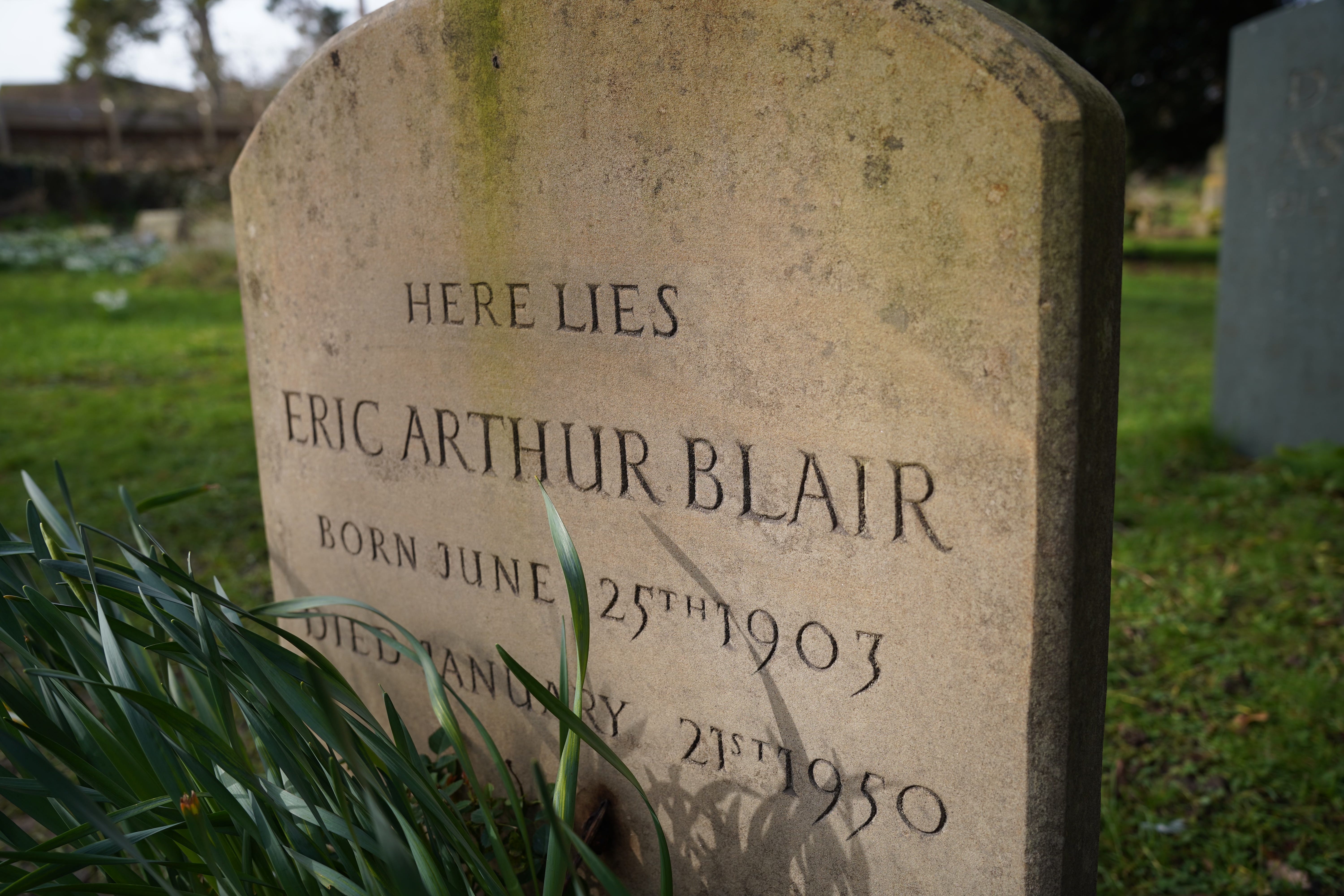
Now more than ever, the writing of George Orwell is critical to understand the conjuncture we find ourselves in. While the author’s headstone situated under a dominating yew tree in a quiet Oxfordshire graveyard represents his physical resting place, his literary legacy extends far beyond the grave and allows us to digest the potent political forces we face today.
The most insightful piece of Orwell I have read is not 1984, Animal Farm or Down and Out in Paris. Rather, the 1941 essay The Lion and the Unicorn: Socialism and the English Genius. Written at the height of the Blitz and some nine years before his untimely death from tuberculosis, the essay offers a gentle critique of British culture, its personas and contradictions.
But perhaps, most importantly, I believe it has significant relevance for today. Britain’s political trajectory towards populism, patriotism and conflict is nothing new; it has identifiable characteristics from wartime which warrant analysis and exploration.
Social class
Class is the great divider of Britain. It has remained the case for centuries, dictating how groups of people coalesce and interact with each other. Orwell states with conviction in 1941 that
‘England is the most class-ridden country under the sun. It is a land of snobbery and privilege, ruled largely by the old and silly.’
Orwell continues, citing how the country is ‘bound together by an invisible chain’, with public opinion providing the remedy for a corrupt ruling class. War went some way to disintegrating social class and the hierarchies that existed up to 1945, but it still remains a stubborn part of Englishness.
‘The war, unless we are defeated, will wipe out most of the existing class privileges. There are every day fewer people who wish them to continue.’
But such class stubbornness now presents the political tramlines for populists. It’s a binary dividing line, pitting the working against the middle and upper. It is the vehicle and the identity from which a scapegoat is borne.
Orwell’s hope of banishing this strict concept never quite manifested, with sharp fragments now piercing through the suppressive film of our contemporary debates.
Patriotism
Patriotism exploits this class division. It taps into atavistic instincts and channels collective desires, especially amongst the working class. But Orwell encourages perceptiveness in 1941
‘In England all the boasting and flag-wagging, the ‘Rule Britannia’ stuff, is done by small minorities. The patriotism of the common people is not vocal or even conscious.’
There is something quite remarkable about the above quote. It reflects today, with the headiness of patriotism capturing the imagination of a minority across the country. All the while, Orwell’s characterisation of the ‘common people’ is separated from this potency, signifying the distance between groups in society.
Orwell also provides the context. He invites us to question who exactly is behind this momentum? Why are they channelling this patriotism, and against whom? And what is the final destination for such activities?
Capitalism
England’s economic system, with its emphasis on private profit, harbours a cold truth for the flag wavers in 1941 and the upper-class. Orwell maintains that being ‘artificially stupefied’ makes the notion of revolution a slim prospect, which would act as an equalising effect in England. However, as he states
‘England is a family with the wrong members in control. Almost entirely we are governed by the rich, and by people who step into positions of command by right of birth… as a class they are quite incapable of leading us to victory.’
It throws doubt on the competency of the upper-class, but also the validity of the working-class’ targeting of specific groups of people - such as immigrants or the unpatriotic. Orwell captures the risk by declaring that
‘The whole moneyed class, unwilling to face a change in their way of life, had shut their eyes to the nature of Fascism and modern war.’
The blindness to the situation - among any class, whether unintentional or deliberate - is dangerous territory. Fixating on the wrong issues, or failing to recognise the wider systemic influences that determine an outcome, risk a crescendo of almighty proportions.

Revolution
Perhaps, as Orwell pens, the solution in 1941 lay in regime change through revolution. It was admittedly a utopian prospect, but again, it has relevance for today. Orwell advocated for socialism, for a settlement that guaranteed nationalised industries as one point among a six-point programme. He remained emphatic that
‘It is only revolution that the native genius of the English people can be set free. Revolution does not mean red flags and street fighting, it means a fundamental shift of power. Whether it happens with or without bloodshed is largely an accident of time and place.’
Orwell offered a prescient insight into what was to come; four years later, Clement Attlee’s Labour government swept to power promising to build a ‘New Jerusalem.’ But at that time, in 1941, he advocated for a socialist revolution that would act as an equaliser.
‘What is wanted is a conscious open revolt by ordinary people against inefficiency, class privilege and the rule of the old.’
Is revolution the solution to our challenges today? There is plenty of verbiage on the topic, especially in the vein of Orwell who advocated for a shift of power. What is perhaps more powerful though is recognising the symptoms that could lead to such an outcome in the future. That way, we remain acutely aware of the undercurrents which influence the trajectory of Britain.